

Genuine Politics or Appeasement?
A Historical Parallel Between Hegseth’s Statem ents on Ukraine and Chamberlain’s Sudetenland Policy
On September 30, 1938, British Prime Minister Neville Chamberlain returned from Munich with a piece of paper in his hand, declaring that the agreement with Hitler to cede the Sudetenland from Czechoslovakia to Nazi Germany would ensure “peace in our time.” In February 2025, US Secretary of Defense Pete Hegseth declared that Ukraine cannot realistically expect to return to its pre-2014 borders and that NATO membership for Ukraine is not an option. These statements raise the question: Is Hegseth’s position an expression of a sober policy, or does it reflect a dangerous appeasement to Russian aggression, similar to Chamberlain’s Politic in 1938?
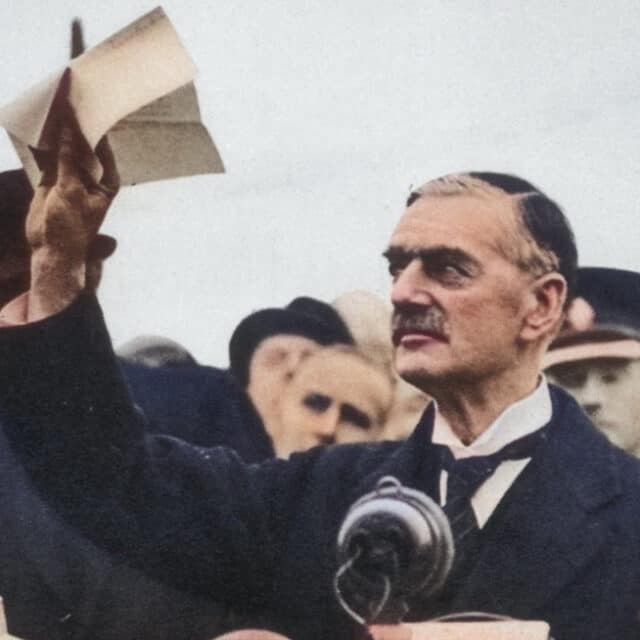
In both cases, we see a great power seeking to avoid a protracted and potentially destabilizing conflict through territorial concessions. Chamberlain and other European leaders in 1938 were determined to avoid another major war in Europe after the devastation of World War I. The Munich Agreement was concluded without Czech representatives, and Czechoslovakia was forced to cede the Sudetenland to satisfy Hitler’s territorial demands. Chamberlain believed that this would satisfy Germany’s expansionist ambitions and prevent a major European war.
Similarly, Hegseth’s statements can be understood as a strategy to end a grueling conflict by accepting that Russia has already gained control of parts of Ukraine. By signaling that the United States will not support a Ukrainian offensive to regain Crimea or the Donbas, Hegseth and the Trump administration may be trying to pressure Ukraine to accept a negotiated peace in which Russia retains the territories it has already occupied. Just as Chamberlain wanted to avoid a war with Hitler, the current US position may be due to a fear of a direct confrontation between NATO and Russia, especially at a time when US military support for Ukraine has become a controversial issue in Washington.
But just as the Munich Agreement did not bring about lasting peace, it is questionable whether Hegseth’s position will lead to a stable and just solution. After gaining the Sudetenland, Hitler continued his expansion, and less than a year later he invaded the rest of Czechoslovakia. History has taught us that concessions are often interpreted as weakness by aggressive regimes, rather than as steps towards lasting peace.
If Russia sees American statements as a signal that the West will no longer fight for Ukraine’s territorial integrity, it could embolden Putin to further aggression, not only in Ukraine, but potentially also against other former Soviet states such as Moldova or the Baltics. Another important aspect of the parallel is the issue of alliances.
Chamberlain excluded the Soviet Union from the Munich talks, thereby weakening a potential alliance that could have deterred Hitler. Similarly, Hegseth’s statements could create divisions within NATO and among Ukraine’s European allies.
If the United States pressures Ukraine to accept territorial losses and abandon the idea of NATO membership, it could undermine NATO’s principle that sovereign nations have the right to choose their own security policies.
This could weaken the alliance’s credibility and make it less attractive to other potential members, such as Sweden and Finland, which recently sought NATO membership to avoid Russian aggression.Ultimately, history shows that appeasement to revisionist powers rarely leads to peace. While it is understandable that the United States and other Western countries want to end the war in Ukraine, Hegseth’s statements risk sending a signal that military aggression is rewarded with territorial gains. Just as the Munich Agreement did not stop Hitler, concessions to Russia may well end up encouraging rather than deterring further aggression. History has repeatedly shown that stability is rarely achieved by giving in to the demands of aggressive powers – on the contrary, it often sets a precedent for even greater territorial claims in the future.
Written by Dennis Jelstrup on facebook https://www.facebook.com/dennis.jelstrup.1/posts/10232149895903232
with reference to this article on danish media
https://nyheder.tv2.dk/politik/2025-02-14-otte-danske-avisledere-advarer-mod-trumps-fredsforslag-i-ukraine